


The Australian designer and zero-waste pioneer shares his vision for sustainable building after visiting the cork oak forests of Sardinia’s Gallura region
Some design buildings. Others design ecosystems. Joost Bakker belongs to the latter. A Dutch-born Australia-based designer, Bakker has been challenging architectural conventions for over 25 years with a virtuous obsession: eliminating the very concept of waste. In 2012, he founded Silo, Australia’s first zero-waste restaurant. In 2021, he built Future Food System, a self-sufficient home in the heart of Melbourne capable of producing food and energy while managing its own waste in a closed-loop system.
Bakker builds with compressed straw and converts organic waste into biogas, but when it came to protecting his buildings from the elements, he found in cork the answer he had been looking for.
Beyond greenwashing: a material that exceeds expectations
Anyone working in sustainability develops a certain level of skepticism, and Bakker is no exception. Every time he encounters a new material, he digs deep to verify that its promises match reality.
With cork, the opposite happened. By visiting the cork oak forests and observing the entire production cycle—from stripping the bark from the oak trees to transforming by-products into construction materials—he encountered a supply chain that exceeded expectations.
What struck him most was the dimension of time: century-old trees bearing the marks of thirty successive harvests, with incisions left by generations of harvesters—some more than a hundred years old. Long before the circular economy became a fashionable concept, it was already everyday practice in the Mediterranean cork forests.
Breathing materials: the lesson of bark
The problem with contemporary construction, according to Bakker, is its obsession with sealing. Over the past fifty years, buildings have been wrapped in rigid surfaces that absorb neither moisture nor sound, resulting in cave-like environments: stale air, poor acoustics, and constant mechanical climate control.
His vision is different. All the materials he uses in his projects are natural, porous, breathable, never sealed—and cork is the perfect example. A cladding that replicates what tree bark does naturally: protecting, insulating, and resisting fire while continuing to breathe.
“Our homes need to be like trees,” Bakker explains. It’s not a metaphor—it’s a design principle.
Three thousand years of building wisdom
In Sardinia, Bakker visited a three-thousand-year-old Nuragic structure: no air-conditioning systems, yet the temperature was stable and the air circulated naturally. Ancient spaces that make people feel at ease—more so than many modern buildings.
The question that follows is simple: why did we stop designing this way? Three thousand years ago, spaces were warm in winter and cool in summer without consuming energy, while today we rely on constant electricity to achieve poorer results.
For Bakker, true innovation does not mean ignoring the past, but integrating it. There is a wealth of accumulated wisdom, built up over generations, that we have set aside—and the challenge is to reclaim it and combine it with contemporary technologies.
Building to regenerate
Bakker’s ambition goes beyond reducing impact: he wants to design buildings that actively improve the environment—structures resilient to fire, storms, and the passage of time.
There is also a health issue. According to the United Nations, up to one hundred thousand people die every year from indoor air pollution, and the air we breathe affects our bodies more quickly than food. Yet we obsess over organic diets while completely ignoring the materials that surround us.
Bakker envisions an organic certification for homes, based on toxin-free materials, without chemical glues or flame retardants. “I truly believe architecture can save us”, he says. Every building made with natural materials is a fragment of the future taking shape in the present.
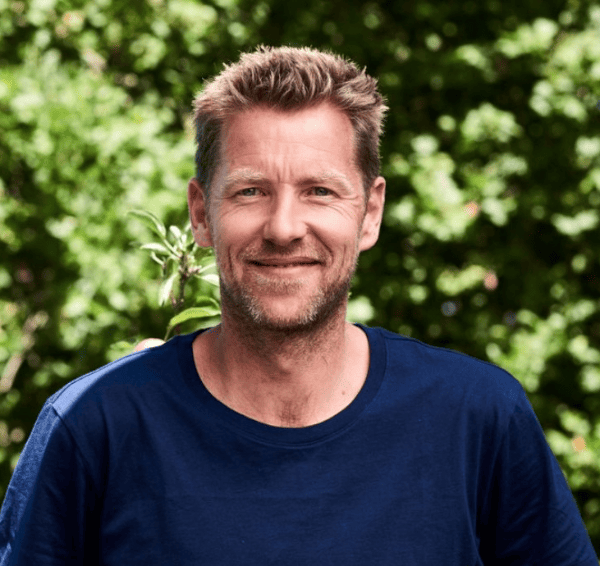
Joost Bakker is an Australian designer and environmental activist. Founder of Silo, Australia’s first zero-waste restaurant, and creator of Future Food System, he is widely regarded as a pioneer of regenerative architecture.
