The cork oak: the treasure and the motive
Cork is a material we are used to seeing in wine bottle stoppers, but also in some household accessories.
This natural material reveals its importance when you explore its secrets and its role in different sectors, above all green building. Thanks to its exceptional insulating properties, cork is used ever more frequently as an ecological, sustainable alternative to common thermal and acoustic insulators.
Its original cellular structure is made up of a honeycomb of thousands of tiny closed cells filled with air, which gives cork a high resistance to the passage of heat and sound. This helps in designing a comfortable environment that is well insulated both thermally and acoustically.
By adding specific granulometries of cork to mortars and plasters, you obtain a product with excellent insulating properties, which can be applied to walls and surfaces simply and safely. Cork-based mortars and plasters are particularly suitable for renovating and insulating existing and new buildings, since they not only improve thermal and acoustic performance but also help reduce environmental impact.
But where does cork come from? What is its origin? Let us discover together a treasure of the Mediterranean, the cork oak.
The life cycle of cork: its natural origins
The cork oak is an ancient, mysterious evergreen that grows in the sunniest parts of the Mediterranean.
The cork oak in fact thrives in Portugal, Spain, France and Italy, the queens of the Mediterranean. It is a fertile plant that gives life to a complex ecosystem: the acorns that fall from its branches feed wild game, enrich the soil with humus and generate new oaks, extending the cork oak forests naturally, without human intervention.
With deep roots that sink almost to the bedrock, it struggles for nourishment and stands as a chest of invisible miracles. At least two thirds of the world’s cork oak forests are found in western Europe and along the Maghreb strip of the African continent, a native woodland heritage that gives cork its depth and identity.
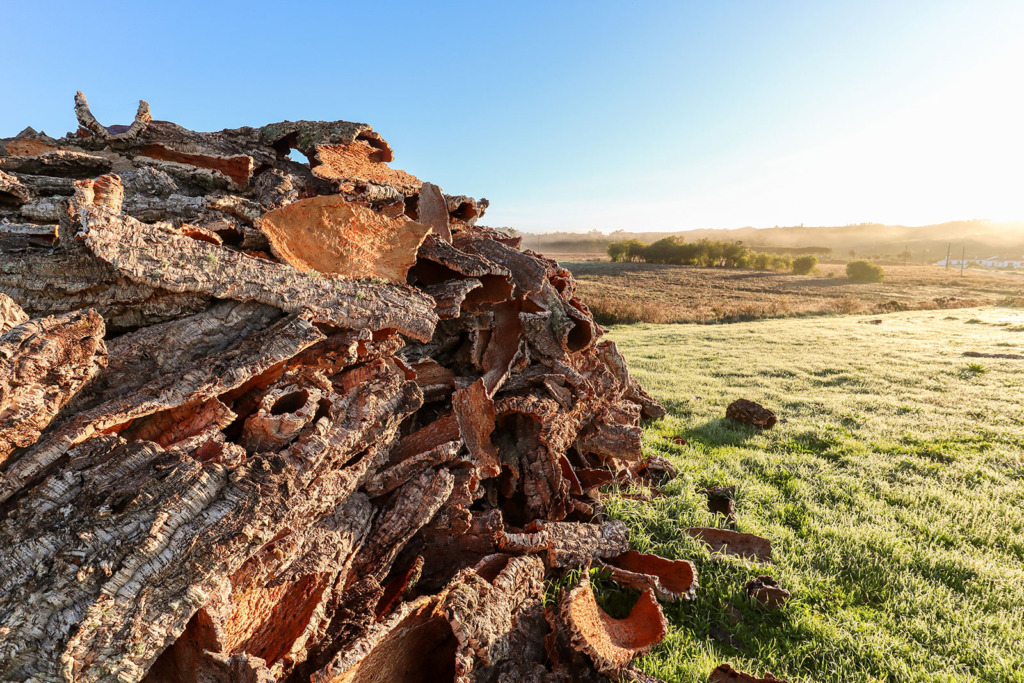
The treasure of the cork oak is its bark, which is harvested without felling the tree. Every ten years, during spring and summer, the precious bark is stripped by skilled “forest sailors”, who work with mastery to remove it while respecting the integrity of the tree.
Thus, after complex processing, a natural product is obtained that respects the environment and stands out for its ability to absorb carbon dioxide. At Diasen we choose only cork from Sardinia, the main cork-producing region in our country.
Choosing Italian cork means obtaining a high-quality product and protecting the different components of a fragile, Mediterranean supply chain.
The wonder of cork
The cork bark is a fascinating enigma, an invisible miracle that reveals itself only through careful observation. It is the result of the extraordinary structure of millions of cells that enclose and trap air, making cork extremely light, elastic and breathable. This peculiar essence is what inspires a passion for cork.
The elementary particles of cork, with their network of cavities and air-filled walls arranged side by side like cushions, account for the many properties and vocations of this extraordinary material. And all this would be unthinkable without suberin, a waxy, hydrophobic layer that makes up almost half of the substance of cork, acting as a covering and seal for the honeycomb mass.
The history of cork goes back to antiquity, when it protected Egyptian vessels, adorned Phoenician pottery and sealed Roman amphorae. Throughout the history of Mediterranean civilisations, cork has provided comfort and shelter to the ancient dwellings of the African limes, a function recognised by ancient botanists such as Pliny the Elder, author of the famous Naturalis historia.
At Diasen we have brought up to date, with modern technologies, the properties and vocation of this incredible natural material.
Cork mortars, plasters and finishes: a revolution in building
From bark to bio-mortar, cork undergoes no chemical treatment that could be dangerous to people or harmful to the environment. After the evocative harvest of the cork bark, an important “seasoning” phase begins, which plays a fundamental role in transforming raw cork into a valuable, versatile material.
Contrary to what one might imagine, the seasoning of cork does not take place in closed, sheltered spaces, but it is left in the open air, in direct contact with sun and rain. During this period the cork loses weight, gives up moisture and sheds dust and tannin, emerging compact, stable and structured.
It is then washed and boiled in large tanks of boiling water, without the use of solvents, sanitisers, alcohol, nothing of the kind. Cork is a 100% natural material from the beginning to the end of its life, which is why it is an excellent alternative to the classic materials that have always been used in construction for thermal and acoustic insulation.
Diasen products
The timeless appeal of cork shows itself through a wide range of innovative products, such as the range Decork, the line of cork-based paints offered by Diasen.
The cork-based paints of the Decork line boast excellent thermal, elastic and water-repellent properties, making every space truly special. Their versatility allows them to be applied both indoors and outdoors, on horizontal and vertical surfaces, with no obstacles at joints or seams. It is a line of highly performing, ecological products, which can be used on different types of materials and surfaces, such as plasterboard or masonry walls, stairs, bathrooms and shower enclosures.
Among the products in this line we find Decork Design, a decorative coating based on cork and water-based resins, known for its high thermal insulation, water repellency and breathability. Ideal for creating fascinating decorative effects on walls, ceilings and floors, this eco-compatible product harmoniously combines functionality and beauty.
Decork Façade, on the other hand, is a coloured finishing coating based on cork and water-based resins, highly elastic and with outstanding thermal insulation and water-repellent properties. Its versatility makes it perfect for the coloured finish of facades, thermal plasters and external thermal insulation systems, giving a touch of elegance and vitality to the exteriors of homes.
Conclusions
The use of cork in construction therefore offers a twofold opportunity: on the one hand, the waste from stopper production is exploited more widely and fully; on the other, the growing demand for sustainable, low-environmental-impact materials in construction and green building is met.
Besides being an eco-compatible material with a low environmental impact, cork is characterised by its durability and resistance over time, giving buildings greater longevity and less need for maintenance.
Cork is preparing for a strategic future as a protagonist in sustainable building. Its growing use as an insulating and finishing material will help promote a more ecological architecture that respects the environment and is able to offer a high level of living comfort.